
Introduction
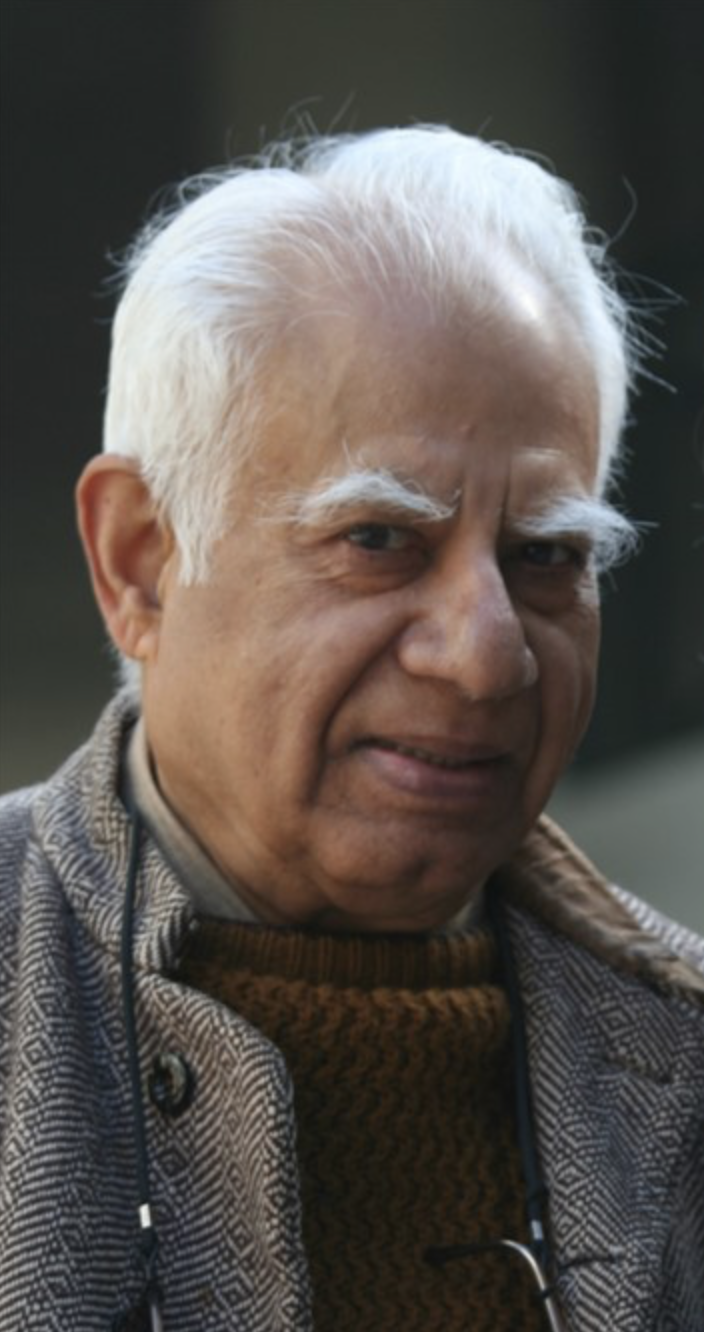
Dr. Shanti S. Tangri led a long and fruitful life. He had a lifelong commitment to learning and to the art and craft of teaching. He was a polymath who knew English, Hindi, Urdu, Punjabi and some Sanskrit. He studied physics, chemistry and economics. In addition to his academic writings, he wrote poems, plays and songs. He taught Economics at Rutgers for 28 years.
While very diplomatic and courteous in his personal life, he loved a good argument. His son Neil Tangri describes him like this: “He loved to debate. He loved to teach. He wanted to be involved in the intellectual life of a community and engaged in current events. Academia fit him to a tee.”
Birth and Family
Shanti was born February 1, 1928 in Rawalpindi in what was then British-occupied India and is now part of Pakistan. His father, Hari Ram Tangri, had a high school education and was an accountant with the Indian Railways, a position that afforded a modest but reliable salary. His job required regular, months-long postings to distant cities such as Karachi and Bombay. He was known for his generosity and scrupulous honesty and rose to be an auditor within the railways. Shanti’s mother, Tej Kaur Jaidka, was born to a landed Sikh family in Ludhiana district but was uneducated. Shanti was the second youngest of seven siblings. His eldest brother, Ved Prakash, and his two sisters, Kailash Kumari and Raj Kumari, died in their teens of disease and accident. His remaining brothers were Satya Prakash, Krishan Kumar, and Om Prakash Tangri. In 1962, he married Sandra Schwartz in Bombay; they had one son, Neil Tangri, before divorcing.[1] His daughter-in-law is Shabana Ansari. His grandchildren are Anaya and Sagar Tangri.
Shanti died at age 96 on May 25, 2024 in Mountain View, California.
Partition[2]
Shanti grew up in Lahore, the principal city of pre-Partition Punjab. His early education was at a local Urdu-medium school, but recognizing his potential, one of his teachers volunteered to tutor him in Hindi so he could gain admission to Dev Samaj Primary School, a Hindi-medium school where he qualified for a scholarship. In 1947 the British Raj was dissolved and the new countries of Pakistan and India were created. Shanti was 19 when the British decided to expedite their departure, leading to widespread rioting. Lahore, a city with a significant Muslim population, became a focal point of violence. Shanti witnessed horrific scenes, including the murder of three Muslims by a Hindu and Sikh mob. He remembers the day: “I saw suddenly people yelling and screaming and coming out of all kinds of streets around… three people running… they got murdered there and within a few minutes the crowd disappeared.”[3]
After a long and dangerous journey, Shanti made it out of Pakistan into Kashmir but he had become separated from his brother. Fortunately, when he arrived in Srinagar in the Kashmir valley, he got some news from an unexpected source.
“My brother Kris had met a fellow student who was [Mahatma] Gandhi’s granddaughter… So I had access to Gandhi that way. I managed to see him for a few minutes in Srinagar in the middle of his very busy schedule… He told me my brother was safe in Banaras.”
In fact, Kris had become engaged to Sita Gandhi, although Shanti didn’t learn this until later.[4]
In addition to learning that his brother had survived the violence, Shanti took the occasion to dispute with Gandhi whether accepting the practice of religion could possibly be the path to peace when the origin of the conflicts in India were in fact religious. As Shanti recalls it, the conversation went something like this:
“You should speak against religion. You know history as well as I do, maybe better. Tell me there was a time when Christians, Muslims, Hindus, have not fought each other? Not killed each other? And tell me why you believe in God. Couldn’t he do any better than produce people like us?
“So, if God is there and God is all powerful… What is his excuse for being such a lousy engineer?” Gandhi was taken aback by my sharpness.
“What should I do?” he asked.
“Denounce religion.”[5]
Eventually Shanti made his way to Delhi where finally his family reunited, none of them killed or injured in the fighting.
He continued his connection to Gandhi, now and then going to prayer meetings at a place called Birla Bhavan. After the prayers–Christian, Muslim and Hindu—Gandhi would talk and people would ask him questions. The last time Shanti saw him was right before Gandhi was assassinated. He recalls the day of the assassination happened to be his brother’s birthday and they were celebrating when:
“…word came that Gandhi died so we all picked up our bicycles and drove down to Birla house. Gandhi had been murdered just about an hour before. His body was lying in a room on the first floor. I couldn’t get up there already. There were hundreds of people around. But my friend, Krishan Bhardwaj, was my neighbor who was very strong and tall. Amazingly, he said just keep your legs stiff. So he literally picked me up and shoved me high enough so I could see Gandhi’s body lying there partly covered in a white sheet. And we hung around for several hours and political leaders started arriving all over. And we saw them. Then Nehru came and a few hours later he stood on a high wall… He gave one of the most moving speeches. I remember the first words still, ‘a light has gone out….’”[6]
Academic Career
After the chaos of partition had somewhat settled, Shanti graduated from East Punjab University, which had been relocated to New Delhi, with a B.Sc. in 1947. He then changed his field of study from physics and chemistry to economics and in 1949 received an M.A. from East Punjab University, by then colloquially known as Camp College for its refugee population.
In his undergraduate days he developed a bit of a reputation as a writer. He started out doing book reviews for the Indian newspaper the Tribune, for Thought, a weekly English magazine, and for the Chronicle, a major newspaper in the capital. In addition, he wrote articles for M.N. Roy, the founder of the Indian Communist Party for Roy’s magazine The Radical Humanist and a book हमारे गाओं, Hamare Gaone (Our Villages) on Indian villages and economics. He also organized theatrical and musical performances among refugee students and through the Indian Peoples’ Theatre Association.
In 1954, he moved to the U.S. to pursue his studies at the University of Missouri where his brother Kris was studying engineering, and then to the University of Kansas. The conclusion he drew from these experiences was, “you can get a first rate education at a third rate school.”
In 1995, he was admitted to the University of California Berkeley to pursue a doctorate. At Berkeley, he threw himself not only into research and writing but also the political and cultural life of the campus.
Shanti was instrumental in building connections among South Asian students and with the broader community. As an organizer with the Indian Students Association, he reached out to Bangladeshi and Pakistani students and grew the membership from 21 to 179. [7]
Shanti’s younger brother, Om, who also was studying at Berkeley, and his fiancé started a group called IND-US. They organized theater, musical concerts, dances, and films. Shanti brought Ravi Shankar to the West Coast for the first time around 1956. The student group Indus continues to this day as INDUS U.C. Berkeley’s South Asian Alliance.[8]
As a Ph.D. student, he petitioned to establish the field of development economics at Berkeley and helped create the first course on economic development at the University. At the time, reading proficiency in two additional European languages was required for a Ph.D. Shanti argued successfully that, as a development economist, he should be allowed to substitute Hindi for one of the languages. He then had to be examined by a faculty member, who was himself not a native speaker of Hindi; the professor had Shanti translate one of his own articles from Hindi into English.
He became friends with the SLATE free-speech crowd at Berkeley, and knew Mario Savio; but as a non-citizen planning to return to India, he didn’t want to take a leading or visible role in protests. The U.S. political climate was still dominated by McCarthy style investigations and foreign nationals were always at risk of deportation.
At U.C. Berkeley, Shanti got to meet many of the movers and shakers in the fields of economics and political economy including: Andreas Papandreou (who later became prime minister of Greece); Harvard economist Marxist Paul Sweezy; and V. K. R. V. Rao, later director of the Delhi School of Economics.
He had a reputation for being absent-minded, which was cemented in his friends’ memories by the incident with his dissertation. When he had completed the first draft of his Ph.D., he somehow lost the one and only copy as well as the outline in a move from Berkeley to Boston for a one-year fellowship. Undeterred by the setback, he rewrote the entire manuscript and was awarded his Ph.D. in 1961.
After Berkeley, Shanti worked at numerous universities around the U.S. and also traveled back to India. But each of the appointments presented challenges and rarely lasted more than a year or two. A particularly bruising and political battle took place at Wayne State University, where Shanti’s status as a non-citizen was held against him. The citizenship issue was a pretext though. As Shanti said in his Rutgers oral history, “My feeling was there were some elements of xenophobia, racism, or something like that, because there were things which they said which indicated to me that it was not just what they were saying which mattered.”[9]
Nonetheless, he became a U.S. citizen in 1968. After proving his point that his citizenship was not the issue, he quit in protest. Not long after, he landed the job at Rutgers University where he would work full-time from 1970 to 1998 and where he was a professor Emeritus from 1998 until his death in 2024.
RUTGERS
Shanti played a critical role in the formation of the economics department of Livingston College, an experimental unit of New Jersey public higher education. The College was created in response to student demands for racial equality, particularly the occupation of Conklin Hall by the Rutgers-Newark Black Organization of Students and it aspired to be multi-racial, multi-cultural and non-sexist. [10]
Thanks to the school’s newness and its experimental nature, Shanti had an opportunity to engage in more than classroom teaching or even research, but institution building aimed at changing higher education in the United States.
In an oral history on the Livingston alumni site, James Simon, Class of ’74, notes “So much of what it introduced – coed dorms, an emphasis on diversity, a disavowal of ivory tower educational philosophy – has become central to the university at large.”[11]
Leslie Garisto Pfaff, an alumna who wrote an article about Livingston’s history, described its role: “Livingston’s curriculum was as groundbreaking as its student population. The college was the first at Rutgers to create departments of Puerto Rican studies, urban studies, community development, anthropology, and computer science.”[12]
At Shanti’s memorial service, Maria Canino, the founding chair of the department of Puerto Rican studies, stated: “Thanks to Shanti’s work we were, if not the first, one of very few in the country that offered an undergraduate course in the economics of Puerto Rico.”
While Shanti was on the fringes of the free speech movement at Berkeley and attended student anti-war protests at the University of Michigan in 1965, the Livingston experiment was the first time he felt free to engage directly as a protagonist in a U.S. project for social change. He brought to it a clear and anti-racist consciousness, likely shaped in part by his early exposure to Gandhi’s movements. He was not native to U.S. culture and was sometimes deeply at odds with what he saw as liberals’ confusion about lowering the bar to admission to combat racism with lowering the standards of academic excellence for U.S.-born Black students or immigrants of color from elsewhere in the world.
He not infrequently found himself at loggerheads with faculty and administrators willing to cut corners on the robustness of grading and curriculum standards. He was a critic of Livingston’s experiments with credit / no credit grading and felt that traditional grades were the best way to communicate a student’s accomplishments and level.
He also pushed for teaching with scientific rigor. His statistics classes weren’t designed to help humanities students meet a math requirement and acquire a vocabulary about math but to actually be able to do statistics. While often seen as a conservative force because of his attitudes about academic excellence, he was also respected as an outspoken advocate for students and faculty when confronting the administration.
In his oral history interview by Rutgers, Shanti recalls a years-long campaign to make econometrics a required course in the department.[13] At that time, the students and the faculty got to vote on changes to curriculum and Shanti lost the vote. However, he was able to turn the tide several years later when one of the students who led the resistance to making the class a requirement got in touch. She worked at one of the major financial institutions in New York and had become a personnel officer.
When they met for lunch, he recalled they had this conversation.
“You were very opposed to [and] leading the opposition against my requiring econometrics, because you were taking statistics and not showing up and then having difficulty, so you figured you will have more problems with econometrics,” I said.
She says, “Yes. Well, I hate to tell you I was wrong. I wish you had forced me to learn econometrics and maybe even more statistics, and I think it would be an absolutely wonderful thing for every economics major to have that. What you said turned out to be true. We get applications from economics kids who have gone to Penn or Harvard, MIT, Columbia. They all have econometrics.”
“Well, you make my heart glad, and this is the kind of comment which [keeps] a teacher going. Would you be willing to come and talk to the students and tell them what you’re telling me?” She said she’d be happy to. I called a meeting [and] invited her to give a talk. We got a vote afterwards, and they approved the teaching of econometrics… It was also good to know that sometimes, not always, things pay off with a long delay.[14]
He saw little purpose in the creation of fake instruments of democratic consultation such as when the administration created advisory boards that didn’t really control the outcome of a decision.
I got a reputation for speaking my mind, not worrying about popularity. They elected me as chairman of the Council of Chairmen. Then, I became, again, by election to the faculty chamber an appointment by the dean of the Committee of the Whole, the entire faculty… Unfortunately, as happens often, the faculty was more given the feeling that we were being consulted and we were participating, but we were really not. I figured the same thing was being done to students. There was a lot of sham.
One professor [laughter] he put it in a way I could never do. He spoke in the faculty meeting here, he said, “Well, I hate to say so but participation in these power structures that the University has created supposedly with getting faculty participation, it’s like masturbation—intellectual masturbation. It gives you the feeling you are in, but you are not.”[15]
When he did engage in a democratic process within the faculty, he stayed committed to the process, accepted his losses and returned to battle for his causes within the process, until he won–or finally admitted defeat.
As recounted by his friend and colleague Peter Klein at Shanti’s memorial service.
“We needed people who could provide some quiet, calming guidance primarily by listening and redirecting the conversations to more useful ways of imagining the future. Shanti did that often – not just at faculty meetings, but even more importantly, in small gatherings of faculty members. He would have so-called pot-luck dinners at his house, which were actually highly organized dinners by Wilma Perez whose energy and joy of living permeated the room. A lot of work got done at those dinners. People could try out proposals in an informal and relaxed way.
“Shanti provided the bridge over what could otherwise easily have been complete chaos.”[16]
Shanti kept teaching economics for 28 years, first at Livingston and then at the School of Arts and Sciences at Rutgers when the various small school experiments at Rutgers were merged. After his retirement in 1998, he continued to participate in the Rutgers community through the emeriti assembly of the American Association of University Professors, the faculty union.
Conclusion
Dr. Shanti Swaroop Tangri had a long life—close to a century—and he lived it fully. He had, at heart, a scientific mind. From his early education in physics and chemistry, to his lifelong career as a teacher of economics, he applied his intellectual keenness and curiosity as he would to a series of experiments. As an immigrant to the U.S., in the McCarthy era midwest, he faced a social and political terrain far different from the Partition-era turmoil of India. But he brought with him a confidence and contrarian character that he had formed in his pursuit of knowledge under extremely difficult circumstances. He was able and willing to challenge “sacred cows.”
In India he challenged Mahatma Gandhi to renounce religion. In the midwest he challenged institutional racism at Wayne State. At Livingston College, he built an economics department from the ground up; starting as the sole tenured faculty and facing down both student and administrators’ assumptions in order to create an institution committed to both equality and excellence.
The memory of Shanti lives on in his descendants and his colleagues and in the articles, oral histories and interviews which he created. Neil Tangri, Shanti’s son, said of his father, “He taught me that finding one’s place in the world is less about finding a place than about making one; and that process can be long, sometimes lonely, always incomplete; but it is a life worth living and celebrating.”
[1] https://en.wikipedia.org/wiki/Sandra_Schwartz_Tangri
[2] https://www.1947partitionarchive.org/
[3] iHeartRadio with Neha Aziz. https://www.iheart.com/podcast/1119-partition-100628607/episode/a-survivors-account-with-shanti-tangri-102205758/ also at: https://podcasts.apple.com/us/podcast/a-survivors-account-with-shanti-tangri/id1635380030?i=1000579913212
StoryCorps with Neil Tangri at https://archive.storycorps.org/interviews/gct002107/
[4] The engagement was postponed and eventually called off due to Gandhi’s opposition Sita mentions the relationship and Gandhi’s role in her memoir, Excerpts from Sita’s memoir are at :http://www.sahistory.org.za/archive/sita-memoirs-sita-gandhi-uma-dhupelia-mesthrie Kris wrote about it extensively in his book The Mahatma and Three Unlucky Lovers, Kris Tangri, Trafford Publishing, 2007. https://www.google.com/books/edition/The_Mahatma_and_Three_Unlucky_Lovers/8pDGMHv-CtoC?hl=en
[5] iHeartRadio with Neha Aziz. https://www.iheart.com/podcast/1119-partition-100628607/episode/a-survivors-account-with-shanti-tangri-102205758/
[6] Final minutes of story corps interview with Neil Tangri, https://archive.storycorps.org/interviews/gct002107/
[7] Rutgers Oral History transcript
[9] Tangri, Shanti. Oral History Interview, August 1, 2013, by Nicholas Molnar and Sean Ferguson, Page #, Rutgers Oral History Archives. Tangri, Shanti Part 1 ( August 1, 2013 ) Tangri, Shanti Part 2 ( December 17, 2013 ) https://oralhistory.rutgers.edu/explore/alphabetical-index/interviewees/2790-tangri-shanti
[10] https://archive.org/details/livingstoncollegealumni
[11] Quoted from Keeping the Rutgers’ Livingston Story Alive 50 Years After the Trailblazing College Opened by Leslie Garisto Pfaff. https://www.rutgers.edu/news/keeping-rutgers-livingston-story-alive-50-years-after-trailblazing-college-opened
[12] https://livingstonalumni.org/oral-history and
[13] Rutgers Oral History transcript
[14] Rutgers Oral History transcript
[15] Rutgers Oral History transcript
[16] A Good Trouble: Peter Klein remarks at memorial service
© 2025. All rights reserved.
Website & Logo design by Afroz Algiers
Photo Credit for background image: Freepik